PTFE, notoriously called Teflon, was not a planned exploration. In 1938, DuPont stumbled upon this remarkable compound rather by mishap, triggering a change in materials scientific research and commercial applications.
One morning in 1938, Roy Plunkett, a young chemist, was busy playing with his experiments behind-the-scenes of DuPont. His task sounded basic: discover a new refrigerant.

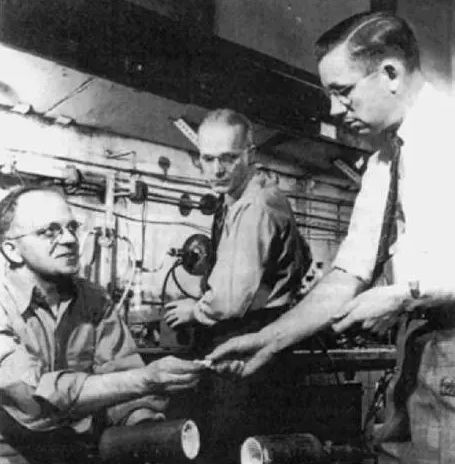
(Roy and his colleagues)
However, simply when Roy assumed it was simply a regular job, things deviated. He saved the tetrafluoroethylene gas in a cyndrical tube and stated to himself: “Okay, see you tomorrow.” The next day, when he returned to continue his experiment, he found that the gas had actually strangely disappeared, leaving just a pile of white powder. Well, this was certainly different from the manuscript he planned. Picture his expression at that time: half overwhelmed, half interested. Upon additional investigation, he uncovered that this unusual white powder had some great superpowers: it was unfriendly to nearly all chemicals, can stay awesome at extreme temperature levels, and was as unsafe as oil. All of a sudden, Luo realized that while he had yet to find a brand-new cooling agent, he had actually accidentally discovered the secret active ingredient of the cooking area superhero of the future – non-stick pans. From then on, frying eggs was no more a difficulty, and cleansing pots ended up being a wind.
Although the discovery of PTFE was accidental, it had substantial cutting edge relevance for the plastics industry and numerous various other fields, such as aerospace, autos, electronic devices, and appliances. PTFE is extensively used due to its unique chemical and physical buildings – incredibly reduced friction coefficient, high-temperature resistance, chemical security, and non-stickiness. From cooking area utensils to vital parts of the space shuttle, PTFE made several cutting-edge applications feasible. Yet while PTFE (Teflon ®) noted a cutting edge innovation in products scientific research, it was just the start of a long and challenging road to commercialization and extensive application. The initial difficulty was not only to uncover a brand-new product however additionally to determine just how to achieve large-scale manufacturing and how to apply it in different fields.
The processes of monomer synthesis and regulated polymerization of PTFE were not fully created, making it difficult to produce PTFE in large amounts or a practical way. While the product’s special residential properties were useful in the end application, they likewise positioned considerable difficulties throughout the manufacturing process. Unlike various other typical plastics, PTFE is not soluble in solvents, acids, or bases and does not merge a flowable fluid. Rather, when heated, it ends up being a hard, clear gel that does not thaw and moves like plastics.
(Roy’s Notes: Discovery of PTFE)
To get over these obstacles, researchers and engineers battled to find processes from other areas, such as adapting methods from steel and ceramic processing. To form PTFE, a process called paste extrusion was used, which was obtained from ceramic handling. Although standard molding and forming techniques had some trouble refining PTFE, it was possible to create PTFE components. By 1947, considerable research study and testing had borne fruit, and a small manufacturing facility was developed in Arlington, New Jersey. This marked the start of Teflon ®’s journey from the research laboratory to the marketplace. In 1950, DuPont opened a new plant in Parkersburg, West Virginia, considerably broadening the commercial manufacturing of Teflon ®. That same year, the technology went across the Atlantic when Imperial Chemical Industries constructed the very first PTFE plant outside the USA in the UK.
Provider of PTFE Powder
TRUNNANO is a supplier of 3D Printing Materials with over 12 years experience in nano-building energy conservation and nanotechnology development. It accepts payment via Credit Card, T/T, West Union and Paypal. Trunnano will ship the goods to customers overseas through FedEx, DHL, by air, or by sea. If you want to know more about polytetrafluoroethylene powder, please feel free to contact us and send an inquiry.
Inquiry us